Be Ready Before
You Need To Be
Prepping isn't paranoia — it's prudence. Disasters, blackouts, civil unrest and supply-chain failures are real events that happen to ordinary people. This guide covers everything from a 72-hour go bag to long-term resilience: water, food, power, comms and the skills that actually matter when the grid goes down.
On This Page
Every prepper starts here. Before you buy a single piece of kit, understand the order in which threats kill you. Use this hierarchy to decide where to spend your time and money first.
Without Air
Airway obstruction, cardiac arrest, toxic atmosphere. CPR and basic first aid take priority over everything else.
Without Shelter
In extreme cold, heat, or wet conditions, hypothermia and heat stroke kill fast. Shelter and dry clothing are second.
Without Water
Dehydration becomes lethal surprisingly quickly, especially with exertion, heat or diarrhoea. Water is your third priority.
Without Food
The body is remarkably resilient without calories. Don't let food anxiety distract you from the priorities above.
Without Community
In a prolonged crisis, isolated individuals fail. Your network of trusted people is your most valuable long-term resource.
A go bag (also called a bug-out bag or BOB) is a pre-packed bag you can grab in under 90 seconds if you need to leave home in a hurry. Aim for a waterproof 50–65L rucksack weighing no more than you can carry comfortably for four hours. Pack it as if you won't return home for 72 hours.
Water & Hydration
- 1L stainless steel or BPA-free water bottle
- Sawyer Mini or LifeStraw portable filter
- Aquatabs or iodine purification tablets (x30 minimum)
- 2L collapsible water bladder for bulk carrying
- Electrolyte sachets (oral rehydration salts)
- Target 2L per person per day minimum
Food (72-hour supply)
- High-calorie energy bars (aim for 500–600 kcal per bar)
- 2–3 freeze-dried meal pouches (just-add-boiling-water)
- Trail mix, nuts, dried fruit
- Hard sweets / glucose tablets
- Compact camp stove (MSR, Jetboil) + gas canister
- Lightweight titanium pot, spork
- Lighter × 2 + waterproof matches
- ~1,800–2,200 kcal/day target per adult
Shelter & Warmth
- Emergency mylar "space" blanket × 2 (retain 90% body heat)
- Lightweight bivy sack (waterproof emergency sleeping bag)
- Compact poncho / rain cover
- Thermal base layer + wool socks (packed dry in a bag)
- Paracord 30m minimum (550-rated)
- Lightweight tarp 2×3m + 6 pegs
- Work gloves (leather palm)
- Hypothermia is a risk even at 10°C / 50°F in wet conditions
Navigation & Signalling
- Paper map of your region (laminated or in a waterproof case)
- Liquid-filled baseplate compass
- Whistle (Fox 40 or similar — heard from 1km+)
- Signal mirror (visible for miles on a clear day)
- Glow sticks × 4 (green for safe, red for help)
- Don't rely on GPS — batteries die, satellites can be disrupted
Light
- Headtorch with spare batteries (or USB-rechargeable)
- Small backup EDC torch
- Solar + hand-crank LED lantern
- Candles × 6 with a small tin for wind protection
- Red-mode headtorches preserve night vision; useful for map reading
Communications
- Hand-crank + solar AM/FM/shortwave radio
- PMR446 (UK/EU) or FRS walkie-talkies paired with family
- Fully charged 20,000 mAh power bank
- 20W foldable solar panel for recharging
- Smartphone (with offline maps pre-downloaded; keep in a Faraday sleeve)
- Written contact list — don't rely on phone memory alone
Medical & First Aid
- CAT or SOFTT-W tourniquet
- Israeli pressure bandage (wound dressing)
- Haemostatic gauze (QuikClot or Celox)
- Wound closure strips + butterfly stitches
- Nitrile gloves × 6 pairs
- Antiseptic wipes + cream, burn gel sachet
- Pain relief (paracetamol, ibuprofen)
- Antihistamines, Imodium, rehydration sachets
- 30-day supply of personal prescription medications
- Printed copies of prescriptions and medical history
- Basic dental repair kit (temporary filling paste)
Documents & Money
- Laminated photocopies: passport, driving licence, insurance, birth certificate
- Emergency contacts list (printed, not just on your phone)
- Cash in small denomination notes (£200 / $200 minimum)
- USB drive with encrypted backups of key documents
- Banks and ATMs may be offline during a grid event
Tools & Fire
- Multi-tool (Leatherman Wave+ or Victorinox)
- Fixed-blade knife (full tang, in sheath)
- Ferro rod / fire steel + tinder (cotton wool + Vaseline)
- Disposable lighters × 3
- Duct tape (small flattened roll)
- Zip ties, cable ties (assorted)
- Heavy-duty bin bags × 5 (shelter, waterproofing, waste)
- Sewing kit (needles, thread, safety pins)
Hygiene & Sanitation
- Hand sanitiser 100ml
- Wet wipes (large pack — personal hygiene without water)
- Compressed toilet paper tablets
- Travel soap bar, microfibre towel
- Toothbrush + toothpaste tablets
- Feminine hygiene products if applicable
- Nappy sacks / biodegradable waste bags
- Disease spreads rapidly in camps — sanitation saves lives
The Bag Itself
- 50–65L waterproof rucksack with padded hip belt
- External rain cover (most bags include one)
- Pack weight: 10–15% of your body weight is sustainable
- Store heavy items close to your back, high in the pack
- Test it: wear it loaded for 4 hours before you need it
- Quality brands: Osprey, Deuter, Berghaus, Karrimor
For Families & Children
- Age-appropriate child go bag (school backpack with their essentials)
- Nappies, formula, baby food if applicable
- Child's favourite comfort item (reduces panic)
- Copies of medical records, vaccination history
- Contact details for school, close family, doctor
- Activity book / cards (managing downtime reduces stress)
- Pet kit: food, water bowl, leash, vaccination records, carrier
Water is non-negotiable. Your body can survive weeks without food; it cannot survive days without clean water. The average adult needs at least 2 litres per day for drinking — more with heat, exertion, or illness. Planning for sanitation, cooking, and hygiene, budget at least 4 litres (1 gallon) per person per day.
💾 Home Storage
- Minimum target: 3-day supply (72-hour kit)
- Ideal target: 2-week supply per household member
- Use HDPE food-grade containers (blue water barrels, Jerry cans)
- Store in a cool, dark location — sunlight promotes algae
- Add 2 drops of unscented bleach per litre to untreated tap water
- Rotate every 6–12 months — set a calendar reminder
- Know the location of your nearest river, stream, or canal as a backup source
- Swimming pools (diluted chlorine) and water heaters are emergency reserves
🔬 Purification Methods
- Boiling: 1 minute at a rolling boil (3 minutes above 2,000m). Kills bacteria, viruses, protozoa.
- Chemical — Aquatabs (NaDCC): 1 tablet per litre, wait 30 minutes. Compact, cheap, essential.
- Chemical — Iodine tablets: Effective backup; not for pregnant women or prolonged use.
- Filtration — Sawyer Mini: Removes bacteria and protozoa (not viruses). Combine with chemical treatment.
- Filtration — LifeStraw: Drink-through filter; same caveat re: viruses.
- Gravity filter — Berkey / Doulton: For home use; removes most contaminants including some viruses.
- Solar disinfection (SODIS): Clear PET bottles left in full sun for 6+ hours. Last resort.
The best food storage strategy is to simply buy a bit more of what you already eat. Rotate your stock on a first-in-first-out basis and nothing goes to waste. Build in layers — short term first, then extend to medium and long term as budget allows.
1–2 Weeks
Everyday Pantry — Buy More of What You Already Eat
These items need no special storage and are used in your normal cooking. Just keep a rolling surplus.
1–3 Months
Freeze-Dried & Dehydrated — Longer Shelf Life, Just Add Water
Freeze-dried meals typically last 25+ years sealed. Dehydrated goods last 5–10 years in cool, dry storage.
1–5 Years+
Bulk Staples — Stored in Mylar Bags Inside Food-Grade Buckets
Add oxygen absorbers and seal. Stored correctly, most bulk staples last decades. Label with date packed.
Most UK/US household power outages last hours to days. Extended blackouts — from severe storms, infrastructure attack, or prolonged grid failure — require a layered approach to both energy and lighting.
⚡ Power Sources (Cheapest → Most Capable)
- Power banks (20,000 mAh+): Immediate, portable, no noise. Enough for several phone charges. Keep at ≥80% charge.
- Solar panel (20–40W foldable): Slow but free recharging for power banks and small devices. Works on cloudy days at reduced output.
- Portable power station (Jackery, EcoFlow, Bluetti): 500–2,000Wh. Run a CPAP, LED lights, laptop, fridge for short periods. Recharge via solar or mains.
- Petrol / diesel generator: High power, noisy, requires fuel storage (add stabiliser, rotate). Never run indoors — CO kills.
- 12V / 24V solar system: Longer-term solution with deep-cycle (AGM or lithium) batteries. Powers essential circuits indefinitely.
🕯️ Lighting & Heat
- LED headtorches (AA): AA batteries are universally available and last years in storage. Carry spares.
- Hand-crank LED lanterns: No batteries needed for basic lighting. 1 min crank ≈ 15 min light.
- Solar garden lights: Charge outdoors, bring inside at night. Surprisingly effective for ambient light.
- Candles: Long burn time; store 50+ for extended outages. Use in a closed tin for stability.
- Camping gas stove: Cooking and boiling water. Store 6+ gas canisters.
- Kelly kettle / rocket stove: Boils water on twigs in minutes. No fuel cost.
- Wood stove: Heat and cooking. Ideal if you have a fireplace. Stock 1–2 face-cords of wood.
| Method | Range | Licence? | Works Offline? | Notes |
|---|---|---|---|---|
| Hand-crank / solar emergency radio | Receive only | No | Yes | Receive national emergency broadcasts, BBC Radio 4 LW, shortwave. Essential for situational awareness. |
| PMR446 walkie-talkies (UK/EU) | ~2km open, less in buildings | No | Yes | FRS / GMRS in the US. Pair with family members. Buy identical models for simplicity. Great for group coordination. |
| Digital mobile radios (DMR / D-STAR) | 5–30km with repeaters | Yes (amateur) | Yes | Much better range and audio quality than PMR. Local amateur repeaters often stay on-air with generators during disasters. |
| Amateur (ham) radio — HF | Worldwide | Yes (full licence) | Yes | The gold standard for off-grid global communications. UK Foundation licence is a weekend course. No mains power needed with a 12V setup. |
| Satellite communicator (Garmin inReach) | Global | No | Yes | Two-way messaging and SOS via Iridium satellite. Subscription required (~£15/month). Works anywhere on Earth. |
| Radar app (BLE / Wi-Fi mesh) | BLE ~100m; relayed further via mesh | No | Yes — fully off-grid | Peer-to-peer encrypted comms with no SIM, no internet, no infrastructure. See the group on a live radar screen. Ideal when everything else is down. |
🩸 Trauma / IFAK (Individual First Aid Kit)
- CAT or SOFTT-W tourniquet (learn to apply one-handed)
- Israeli pressure bandage (emergency wound dressing)
- Haemostatic gauze (QuikClot or Celox) for severe bleeding
- Chest seal (Hyfin vented) for penetrating chest wounds
- Wound closure strips + butterfly stitches
- Trauma shears
- Nitrile gloves × 6 pairs
- Take a Stop the Bleed or first aid with CPR course
💊 General Medical Kit
- Assorted adhesive dressings, sterile gauze pads
- Triangular bandage (sling), SAM splints × 2
- Medical tape (Micropore + zinc oxide)
- Antiseptic wipes + cream, burn gel dressings
- Eye wash (sterile saline pods)
- Digital thermometer, blood pressure cuff
- Paracetamol, ibuprofen, aspirin
- Antihistamines (cetirizine or chlorphenamine)
- Loperamide (Imodium), antacids, oral rehydration sachets
- 30–90 day supply of personal prescription medications
- Dental repair kit (temporary filling paste, clove oil)
💵 Cash & Documentation
- Keep at least £200–£500 / $200–$500 in small notes at home — secured but accessible
- Include coins for parking, machines, and small transactions
- Consider gold or silver coins for long-term, high-inflation scenarios (1oz silver coins are highly liquid)
- Diversify savings across at least two financial institutions
- Store copies of account numbers, bank details, and insurance policies securely off-site or encrypted
- Consider a fireproof / waterproof document safe at home
🤝 Barter Goods
In prolonged shortages, people trade what others need. Store modest quantities of high-value barter items:
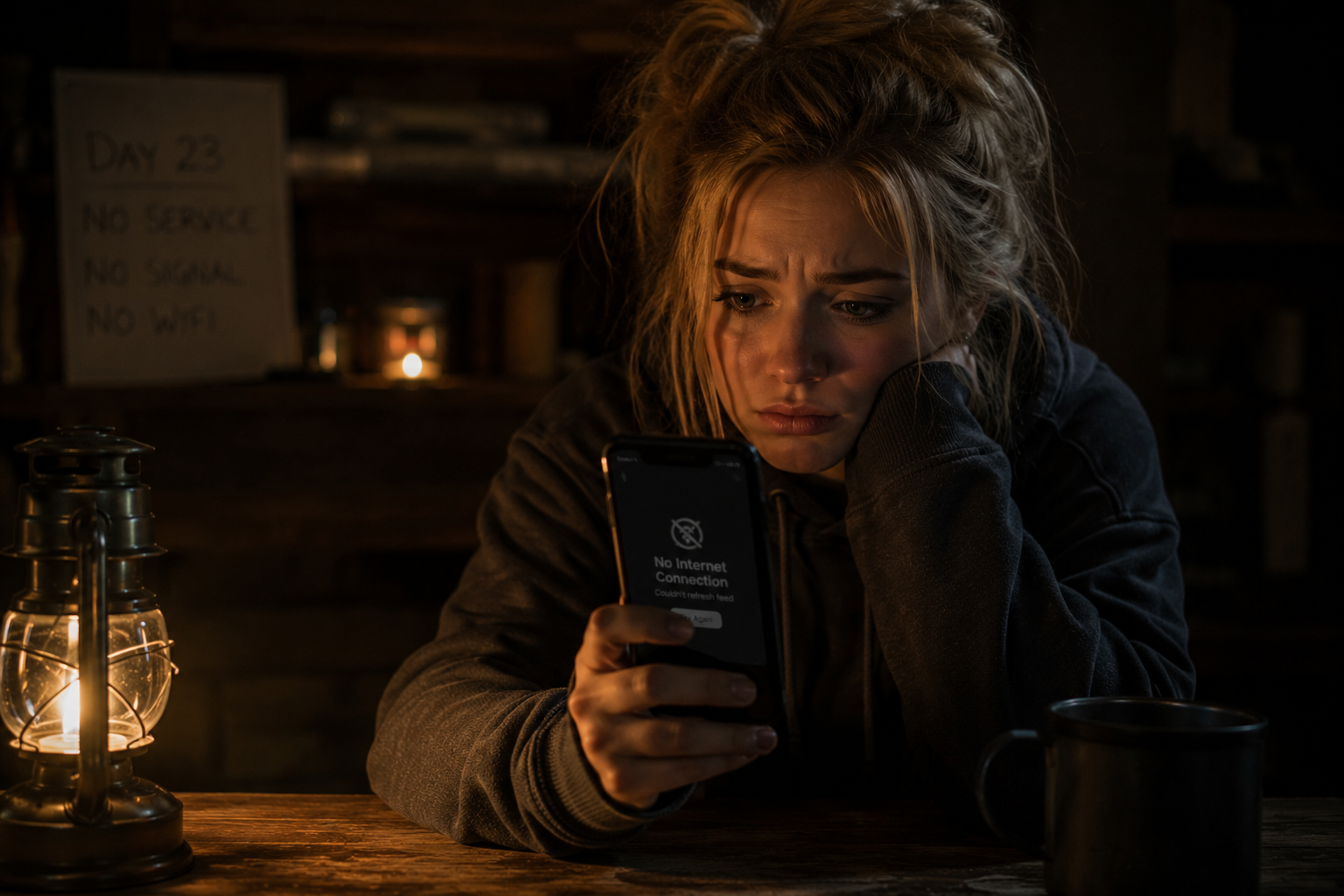
Your smartphone is no longer just a communication device — it is your bank, your identity, your keys, your diary, your two-factor authenticator, and your emergency contact list. A lost, broken, or stolen phone — or simply a prolonged loss of mobile signal and internet — can leave you cut off from almost everything that matters. This section covers what you stand to lose and, more importantly, what you can do about it now.
2FA & Authenticator Apps
- Google Authenticator, Authy, Microsoft Authenticator — lose your phone, lose access to every account that uses them
- Email, banking, work systems, social media, cloud storage — all locked behind a code only your lost device can generate
- Recovery process can take days or weeks; often requires identity verification you can't complete without the account you're locked out of
- This is the single most disruptive thing most people will face when they lose a phone
Banking & Financial Apps
- Mobile banking apps — can't check balances, transfer money, or approve payments
- Transaction approval — many banks now require in-app approval for online card purchases; without your phone, your card is effectively frozen for online use
- Contactless mobile payments (Apple Pay, Google Pay) cease immediately
- Crypto wallets — if your wallet app is only on your phone and you have no seed phrase backup, your funds may be permanently inaccessible
- Hardware wallets (Ledger, Trezor) and written seed phrases stored offline are essential
Email & Gmail
- Loss of access to incoming messages — bills, notifications, correspondence
- Gmail is often used as a password reset address for dozens of other services — lose it, lose everything downstream
- Inability to respond to urgent communications from employers, family, or emergency services
- Shared family calendars, documents, and Drive files become inaccessible
- Memorise your email password and ensure you can log in from any browser
Contacts, Notes & Messages
- Most people can't recall more than 2–3 phone numbers by memory — everyone else is gone
- Years of WhatsApp, Signal, Telegram message history — gone or inaccessible
- Notes apps (Apple Notes, Google Keep, Samsung Notes) holding passwords, addresses, account numbers, PINs — lost
- Security risk: if your phone is stolen or found, an unlocked or easily guessed device gives a stranger access to everything listed above
- Unencrypted notes containing passwords or financial data are a serious vulnerability
Cloud Backups & iCloud
- iCloud / Google Photos — years of photos and videos inaccessible if your account is locked or internet is down
- App data, saved games, and app settings — not restored on a new device until you regain access
- iCloud Keychain passwords unavailable if your Apple ID is locked or you're offline
- Shared family albums and memories at risk if the primary account holder is unreachable
- Cloud backups require internet to be useful — offline physical backups are essential
Home Automation
- Smart heating (Nest, Hive, Tado) — can't adjust temperature or schedules remotely; app-only controls become useless
- Smart security cameras (Ring, Arlo, Eufy) — no live view, no alerts, no recorded footage review
- Smart locks (Yale, August) — app-only access codes may be unworkable; know your physical key override
- Smart lighting, plugs, and appliances — automation routines fail if hub or internet is lost
- Smart doorbells, alarm monitoring apps, and CCTV alerts all go dark
- Always test the manual override for every smart home device you own
Accounts
Back Up Your 2FA Access Before You Lose It
This is the highest-priority step. Do it this week.
- For every service using an authenticator app, print or handwrite the backup / recovery codes provided when you enrolled — store them in a fireproof safe or sealed envelope off-site
- Consider switching to Authy instead of Google Authenticator — Authy supports encrypted cloud sync and multi-device access, so you can recover on a new phone
- Consider a hardware security key (YubiKey) as a second 2FA method on critical accounts (Gmail, banking, work) — it works offline, has no battery, and survives a phone loss
- Write down the account recovery email address and phone number registered on each major account, and keep this list physically secured
- Google, Microsoft, Apple, and most banks all have account recovery processes — but they take time. Backup codes are instant.
Crypto
Ensure You Can Access Money Without Your Phone
- Write down key bank account numbers and sort codes — stored separately from cards, in a physical safe or secured at a trusted family member's address
- Know your bank's telephone banking number and your telephone banking PIN / passphrase — phone banking bypasses app requirements entirely
- Carry a physical card with a memorised PIN; know which card doesn't require an app for transactions
- For crypto: write your seed phrase (12 or 24 words) on paper or metal — store in two physically separate secure locations; never digitally
- Consider a hardware wallet (Ledger, Trezor) — these work independently of any phone or app
- If your crypto seed phrase only exists on your phone, you don't own your crypto — you're borrowing it until the phone dies
Numbers
The Written Phone Book — Don't Dismiss It
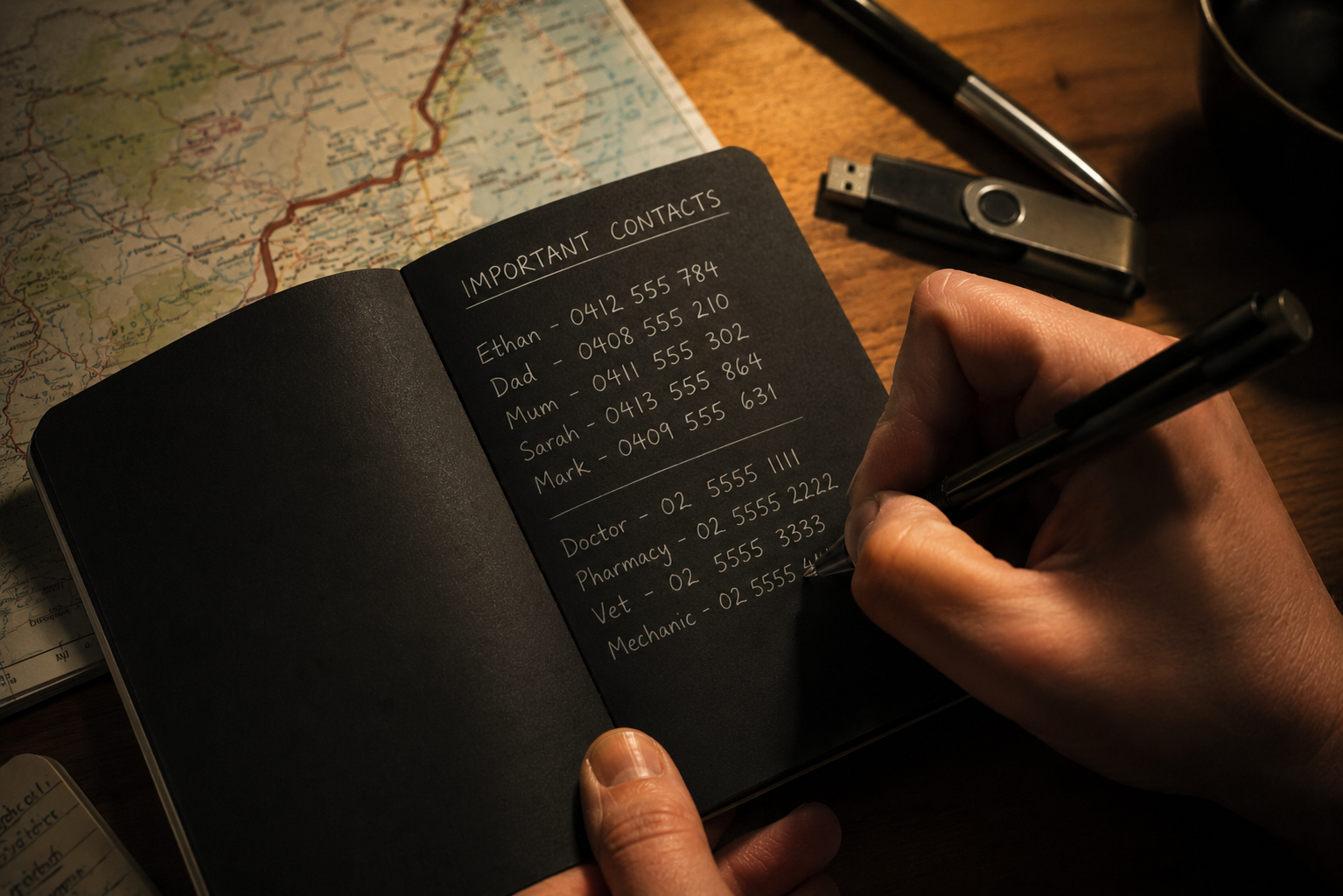
- Print or handwrite the 20–30 most critical phone numbers: immediate family, close friends, GP, dentist, insurance, workplace, breakdown cover, neighbours
- Laminate it or put it in a plastic sleeve and tape it inside a kitchen cupboard or to the back of your router
- Include full postal addresses for the people you'd need to reach in person if communications failed
- Give a copy to each adult in your household and to a trusted person outside it
- In an evacuation, you will not have time to try to remember numbers. Have them on paper in your go bag.
Notes
Offline Password Management and Secure Notes
- Use a password manager (Bitwarden, 1Password, KeePass) — do not store passwords in phone notes apps or browser autofill alone
- KeePass stores your vault as an encrypted local file — back this up to a USB drive (not just to cloud); you can access it offline on any computer
- Print a "break glass" sheet with your 10 most critical passwords (email, banking, work) — store in a fireproof safe; update it annually
- Never store PINs, bank details, or passwords in unencrypted phone notes — Notes, Notepad, and standard SMS are all plaintext
- Use Standard Notes (end-to-end encrypted) or the encrypted notes section of your password manager for sensitive information
Backups
Physical and Offline Backups for Irreplaceable Data
- Run regular backups to a physical hard drive or USB — not just iCloud or Google Photos, which require internet and an active account to access
- Print the most important photos — a physical print survives a cloud account being hacked, suspended, or an internet outage
- Keep a USB drive in your go bag with a copy of key documents, photos, and your KeePass vault
- Export and save contacts as a .vcf file periodically; store it on the USB drive alongside your documents
- Cloud backups are excellent for convenience — but they are not a substitute for a physical copy of irreplaceable data
Home
Test Your Manual Overrides — Right Now
- Smart heating: locate and test the physical thermostat controls; know how to set a manual programme without the app
- Smart locks: confirm you have a working physical key for every smart lock in your home; test it; keep a spare with a trusted person
- Security cameras: configure local SD card recording where possible — so footage is captured even if the cloud subscription or internet goes down
- Smart alarms: confirm the alarm has a manual PIN keypad and that every household member knows the code without looking it up on their phone
- Know how to disable your smart home hub safely during a power cut (incorrect shutdown sequences can corrupt some hubs)
- Smart home devices are convenient. In an emergency, convenience becomes a liability if there's no physical fallback.
Device
Consider a Backup Phone
- Keep an old smartphone in a drawer, factory-reset and charged — it can connect to Wi-Fi even without a SIM and run apps, authenticators, and cameras
- A cheap prepaid SIM card (£5–£10 with credit) on a different network gives you a second number and data connection if your primary network is down
- A basic feature phone ("dumb phone") — Nokia 3310 style — makes calls and sends texts on minimal power for days; useful when a smartphone would be dead
- If evacuating, grab your charger cable and power bank instinctively — a dead phone is worse than no phone
- In a regional emergency, one network often goes down while others remain up. Having a SIM on a second carrier is genuine redundancy.
A well-prepared person with modest kit and solid skills will consistently outperform a poorly-skilled person with expensive gear. Invest in knowledge and practice before buying more stuff.
First Aid & CPR
Take a certified course (St John Ambulance, Red Cross). Learn Wilderness First Aid for extended-care scenarios.
Fire Starting
Practice starting a fire in wet, cold conditions with a ferro rod and natural tinder before relying on it in an emergency.
Map & Compass Navigation
Take a navigation course. Practice on local walks. GPS fails; paper maps and a compass do not run out of battery.
Water Purification
Know how to find, collect, filter, and chemically treat water from natural sources. Practice before you need to.
Food Preservation
Learn to preserve food by canning, dehydrating, fermenting (sourdough, kimchi, sauerkraut), and pickling. These skills massively extend your food supply.
Growing Food
A vegetable patch or even a window box of salad greens reduces dependency on supply chains. Know which plants grow in your climate.
Basic Carpentry & Repairs
Know how to fix a door, patch a roof, board a window, and make basic shelters. A hammer, saw, and screwdriver are invaluable.
Amateur Radio
The UK Foundation licence is a 2-day course and opens up enormous communication capability. In the US, the Technician licence covers most practical needs.
12V Solar Electrical
Learn to wire a basic 12V system: solar panel → charge controller → battery → inverter. Powers lights, phone chargers, and small appliances indefinitely.
Community Building
Know your neighbours. Identify useful skills locally: medics, mechanics, farmers. A trusted network of five people is worth more than a tonne of tinned food.
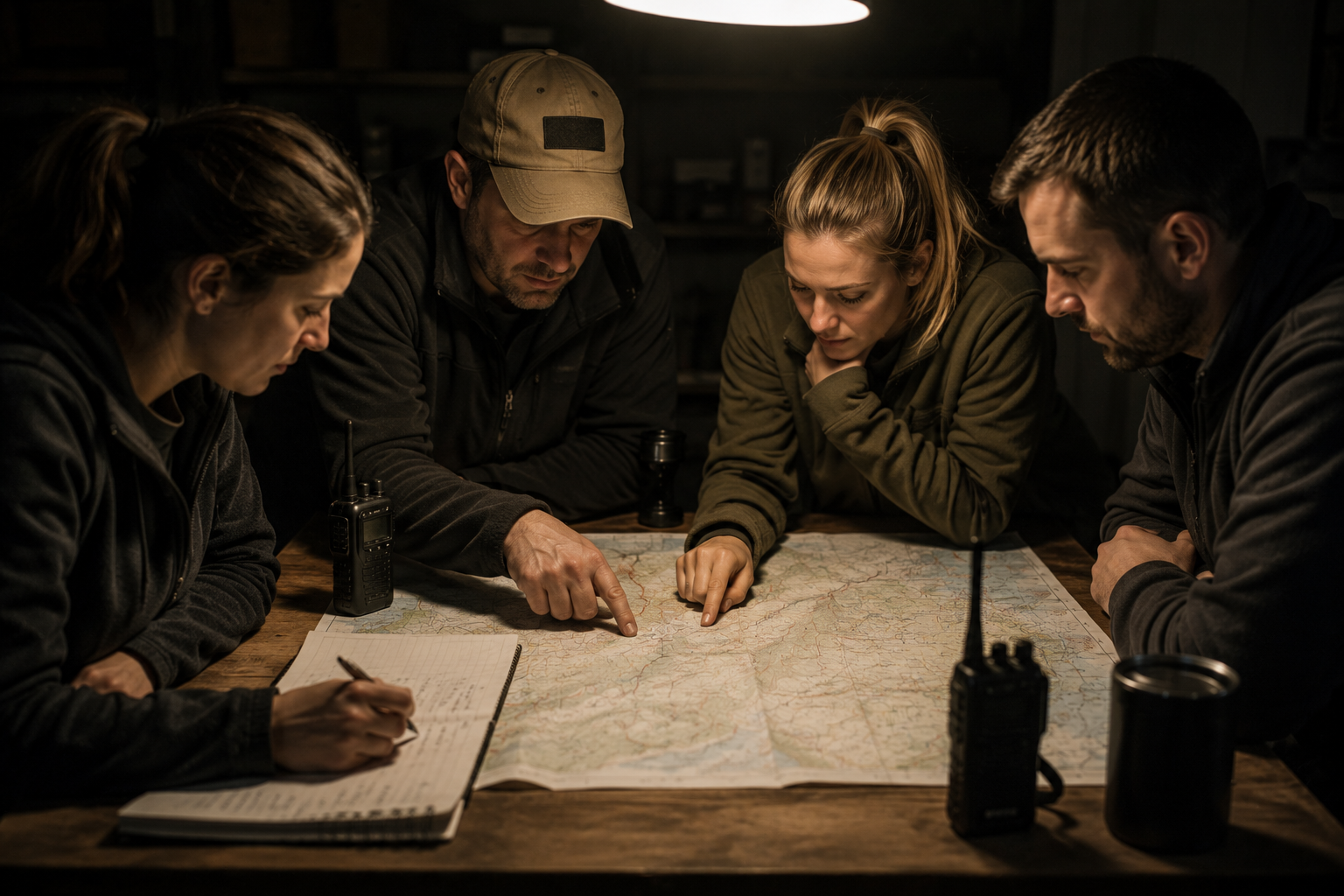
Every item in this guide becomes more effective when you can coordinate with the people around you. Radar is an Android app that creates a fully off-grid, peer-to-peer mesh network using Bluetooth LE and Wi-Fi Direct — no SIM card, no internet, no cell tower, no infrastructure of any kind required.
Truly Off-Grid
- Works without any internet connection
- Works without a SIM card or phone signal
- No servers, no infrastructure, no single point of failure
- Peer-to-peer encrypted communications
Radar View
- See your group on a live radar-style display
- Track positions of family and team members nearby
- Works in urban environments, woodland, buildings
- No GPS lock required for relative positioning
Encrypted Messaging
- Send text messages and files peer-to-peer
- End-to-end encrypted with no central relay
- Supports voice and video calls over local Wi-Fi
- SOS and emergency alert broadcasting